
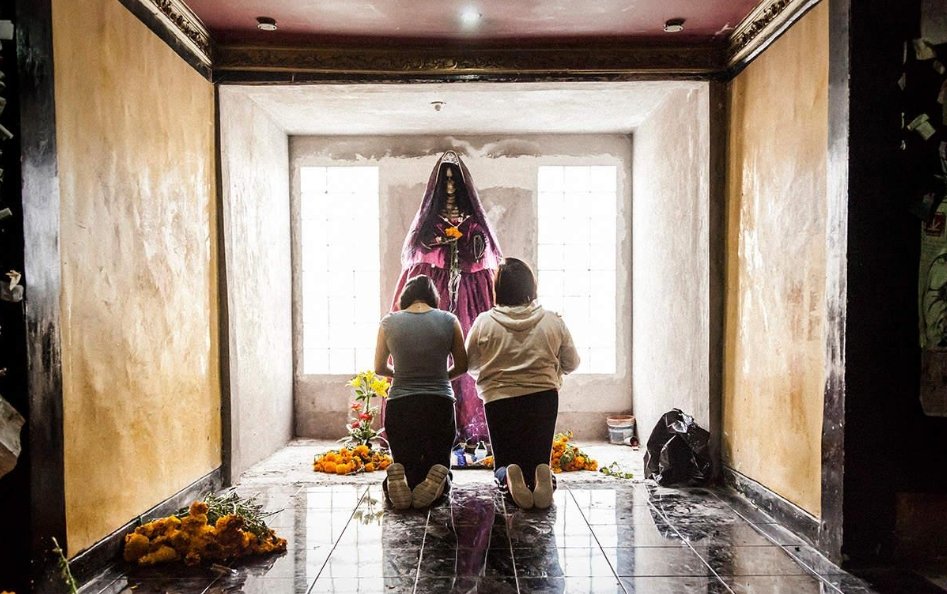
There is a new religious landmark taking shape in Arizona, and its centerpiece is probably not what most people would expect to see at a place of worship. A 55 acre development known as Manto Sagrado is being planned as a major destination for devotees of Santa Muerte, the skeletal folk saint whose name translates roughly to “Holy Death” or “Saint Death.”
According to reporting published by The Arizona Republic on Aug. 14, the project is expected to become the largest Santa Muerte community in the United States. That is a pretty significant development for a spiritual movement that has spent much of its modern history operating through private home altars and small devotional spaces.
If your first reaction to Santa Muerte is that she looks like the Grim Reaper wearing a dress, you’re not wrong about the appearance. (We mean no disrespect in that description). She is generally depicted as a female skeleton dressed in a robe and may be shown carrying a scythe, globe, hourglass or other objects. What that image represents to her followers, however, is considerably more complicated than simply worshipping death.
Santa Muerte is often approached as a protector and intercessor. Devotees may ask her for protection, healing, financial help, love or safe passage through dangerous circumstances. For many of her followers, acknowledging death is actually part of asking for protection from it.
WHO IS SANTA MUERTE?
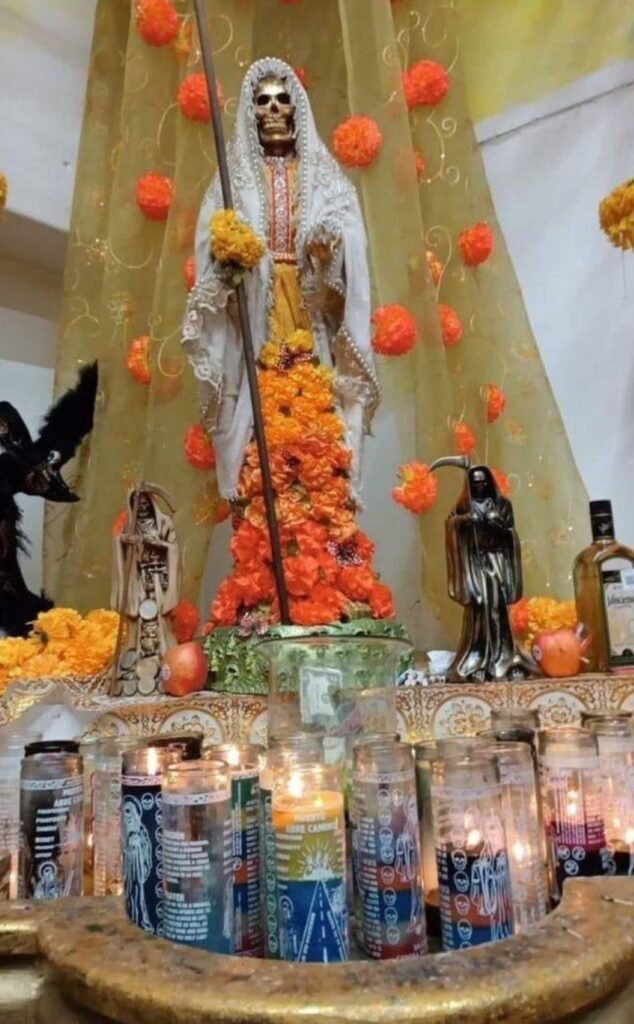
One thing worth clearing up immediately is that Santa Muerte is not recognized as a saint by the Roman Catholic Church. She is generally described by scholars as a folk saint and as the central figure of a newer religious movement that developed in Mexico and has since spread throughout the United States and elsewhere.
Her history is complicated, which is why describing her simply as an ancient Aztec goddess would be an oversimplification and truly misleading. Scholars generally understand modern Santa Muerte devotion as the result of cultural and religious influences coming together over centuries, including Indigenous Mesoamerican traditions surrounding death and Spanish Catholic imagery and practices. Her modern public devotion became especially visible in Mexico City in the early 2000s, when Enriqueta Romero established a public shrine in the Tepito neighborhood.
That history is important because Santa Muerte is not simply a character pulled from an ancient mythology and carried unchanged into the present. The figure has evolved through Mexican religious culture and continues to evolve as devotion spreads.
THE ALTAR IS WHERE THE PERSONAL STUFF COMES IN
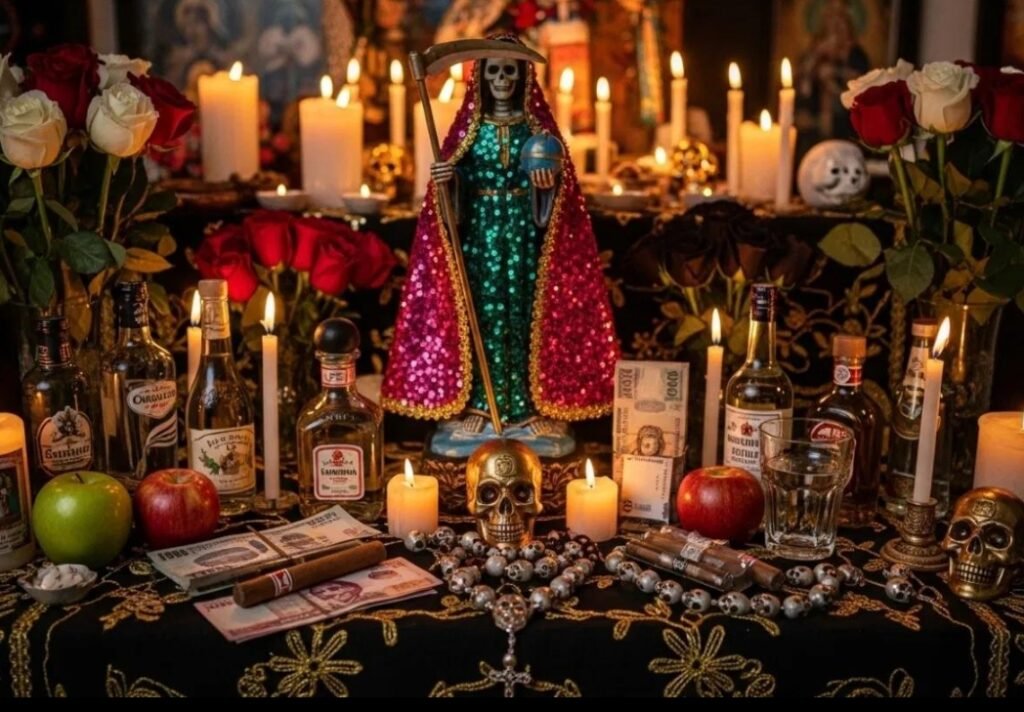
Santa Muerte devotion can look surprisingly familiar if you’ve spent any time around Catholic devotional practices. Altars may contain candles, flowers, incense, food, photographs, religious objects, coins and personal offerings, with the skeletal figure at the center. The colors associated with Santa Muerte can also carry different meanings depending on the devotee and the particular petition being made. There isn’t one universal rulebook governing every altar or every person’s relationship with her.
That flexibility is part of the appeal.
Santa Muerte has become a spiritual figure for people seeking help with very real problems, and researchers studying her devotion have found that her followers cannot simply be reduced to one particular social group or motivation.
NO, THIS ISN’T “MEXICAN VOODOO”
Santa Muerte is sometimes lumped together with traditions such as Vodou, Hoodoo, Santería or brujería, but that isn’t accurate. These are distinct religious and spiritual traditions with their own histories and practices. There is a broader connection in the sense that these traditions demonstrate how religious practices can develop through cultural exchange, migration, and the blending of different influences. Santa Muerte itself reflects that complicated history, particularly the meeting of Indigenous Mexican traditions and Catholicism.
And while some devotees incorporate Catholic prayers, rosaries, crosses and saints into their practice, that does not make Santa Muerte an accepted part of Catholic doctrine. The Catholic Church has repeatedly rejected devotion to her as we have mentioned before.
SANTA MUERTE COMES TO ARIZONA
The Manto Sagrado project is another indication of how far Santa Muerte devotion has moved beyond small private altars. Public devotion to Santa Muerte has grown significantly since the early 2000s, including throughout the American Southwest, where established temples and devotional communities already exist.
For her followers, Manto Sagrado is a place where their faith can exist openly and collectively.
For people unfamiliar with Santa Muerte, a massive religious community centered around a skeletal representation of death may sound like something lifted directly from a horror movie. But that interpretation misses what the figure means to the people who actually practice the devotion.
Santa Muerte isn’t a horror character, and her followers aren’t automatically criminals or occultists simply because of the imagery associated with her. She is a complicated folk religious figure whose devotion has grown dramatically and whose meaning varies from one devotee to another.
Maybe one day we will all be able to worship and show our faith in whatever we may hold dear without the judgement of others, but we have a feeling that will be a very long time still, not only in the United States let alone Arizona but the world.