

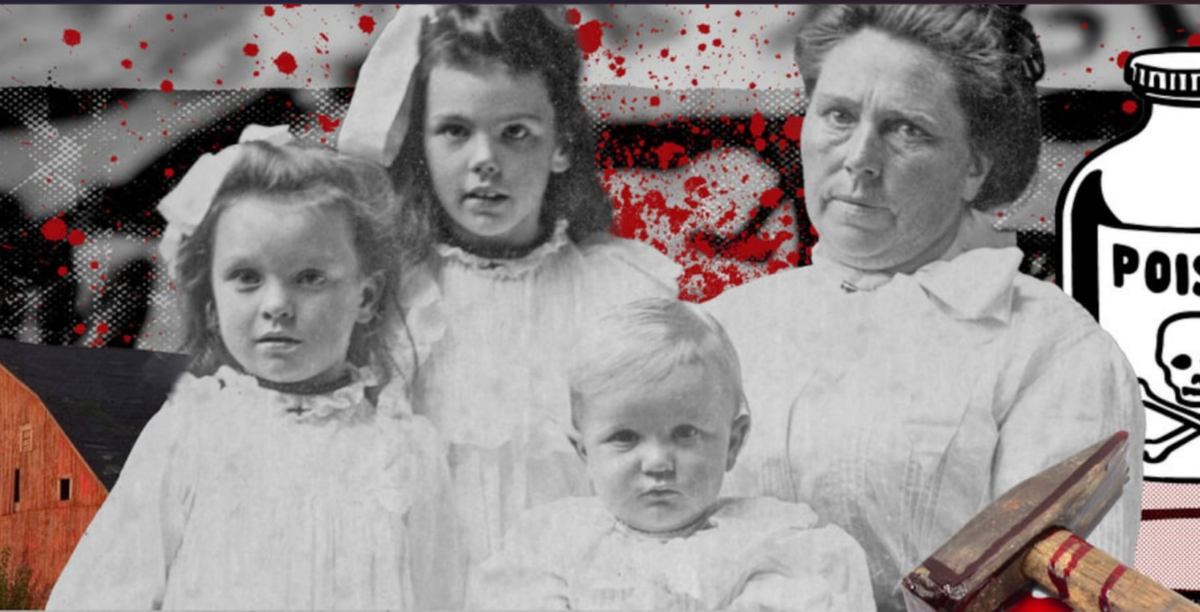
Some would say she was one of the rarest kinds of psychopaths: a woman who engaged in wholesale murder and dismemberment. What makes Belle Gunness particularly disturbing, however, is the sheer brutality of her crimes.
There were other killers during her time, but many relied on the same methods used by countless others: poisoning their victims, then pretending nothing was wrong while claiming they had died of natural causes. Belle Gunness was different. Sure, she wasn’t above getting rid of a troublesome child or spouse who got on her nerves with a little strychnine when necessary. But the bodies discovered on the infamous Indiana murder farm weren’t simply victims of poison. They had been butchered.
Belle was a 42-year-old Norwegian immigrant who purchased her farm using an insurance payout following the sudden death of her first husband, Mads Sørensen, who reportedly died after suffering violent convulsions and agony. Her first two children? Yep, them too. Both were heavily insured and reportedly died under similar circumstances.
The symptoms pointed toward strychnine poisoning, but the doctors who examined the bodies found nothing suspicious enough to raise the alarm.
A Farm Built on Insurance Money
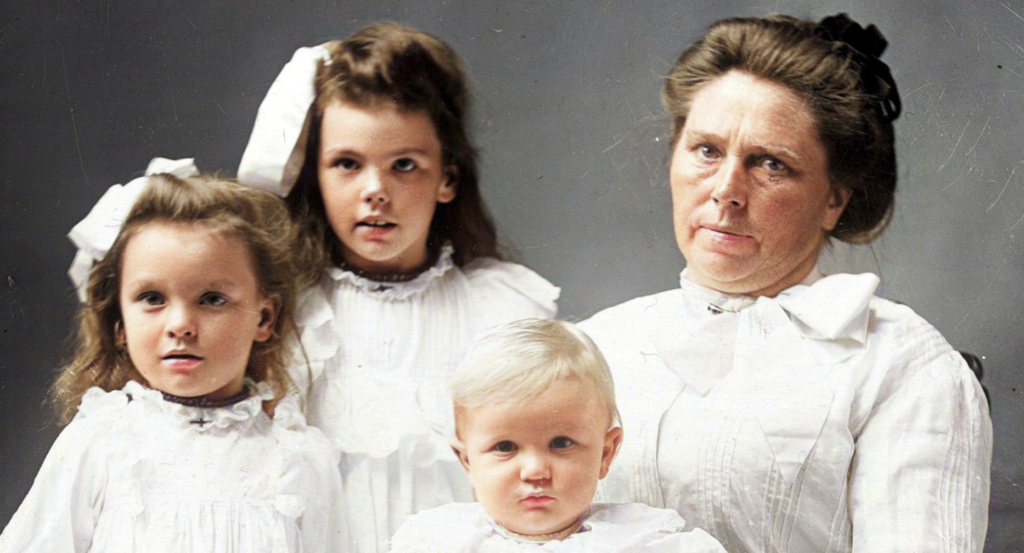
Belle eventually moved to the small town of La Porte in northern Indiana and established herself on a farm. It wasn’t long before she married a young widower named Peter Gunness. Just nine months after they tied the knot, Peter was dead. Apparently, an iron sausage grinder fell on him, striking him directly between the eyes while he was reaching for a shoe. At least, that’s what Belle told authorities.
The story was so ridiculous that even the neighbors were talking murder. Yet, somehow, the insurance company ruled his death an accident, and Belle walked away with another check.
That’s when things really kicked up a notch. Over the next six years, a succession of men found their way to Belle Gunness’ happy little home in the country. Some were hired hands brought in to help around the farm, while others were well-to-do bachelors lured there by the various marriage ads Belle placed in Norwegian newspapers of the time. They came looking for work, companionship or perhaps a chance at love.
The one thing they all had in common? None of them were ever seen again.
The Fire That Exposed the Murder Farm
Then, in the early morning hours of April 27, 1908, the Gunness farm burned to the ground. When the flames were finally extinguished, firefighters were in for quite a shock. Inside, they discovered four bodies stacked like winter firewood: three children and an adult woman. The children were identified as three of Belle’s youngest. The fourth body was believed to be Belle herself. There was just one problem. The woman’s head had been cut off, and it was nowhere to be found.
Suspicion immediately fell on one of Belle’s disgruntled workers, Ray Lamphere, who was eventually charged with murder. In the meantime, searchers continued sifting through the burned-out remains of the farmhouse, hoping to find the missing woman’s head. They never did. But what they did find would make Belle’s story even more disturbing and infamous.
A dozen butchered bodies were discovered buried around the property, scattered between a trash pit, a privy vault and the chicken yard. Each had been carved up like a Thanksgiving turkey. Heads hacked off, arms removed at the shoulder sockets and legs sawed off at mid-thigh. The various body parts, including limbs, heads and torsos, had been stuffed into separate grain sacks, sprinkled with lime and buried.
America’s Female Bluebeard

The discovery of these atrocities turned the Gunness farmstead into an instant macabre tourist attraction. The following Sunday, an estimated 10,000 curious onlookers descended on the property, some traveling from as far away as Chicago. Entire families could be seen wandering the grounds while hawkers sold everything from hot dogs and lemonade to souvenir postcards. The postcards featured Belle as “America’s Female Bluebeard,” the nickname newspapers had quickly given her. (The nickname was a reference to Bluebeard, the infamous character from the French fairy tale who murdered his wives and hid their bodies inside his castle. Like her fictional counterpart, Belle lured men to her home under the promise of marriage, only for them to meet a gruesome end.)
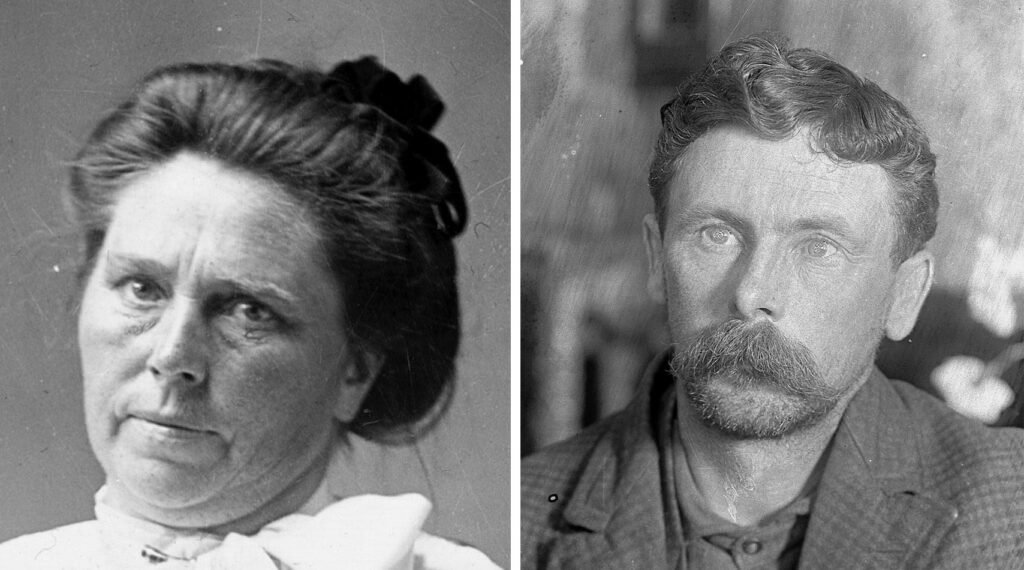
Under arrest, Lamphere, who turned out to be more than just a hired hand but Belle’s lover as well, reportedly told a disturbing story. According to his account, every victim had been murdered for money. But greed wasn’t Belle’s only motive. She was also described as a sexual predator. Despite her 250-pound frame and mannish features, she reportedly possessed a seductive charm. Her victims were lured into a private bedchamber, where they were allegedly chloroformed before Belle finished them off with an axe.

Date: 1908 Source Type: Postcard Publisher, Printer, Photographer: Unknown Postmark: June 1, 1908, LaPorte, Indiana Collection: Steven R. Shook Remark: Though no description is found on the front of this postcard, the message written on the reverse by Roy Standish to his father B. R. Standish of Falconer, Chautauqua County, New York, identified it as the Belle Gunness farm in LaPorte County, Indiana. The message reads as follows:
The Door, Ind May 31
This is the yard where they dug the bodies out of and shows a little lake in the back ground. at the left of the picture is holes you can see where 4 bodies were found. I will will you some more of these cards after a while. Your son Roy.
The Woman Who May Have Gotten Away
As for Belle’s actual fate, the questions still linger. Did Lamphere, her suspected accomplice, kill her and her children for reasons that remain unknown before setting fire to the entire property in an attempt to cover up his crimes? Many believed so.
Others, however, believed the charred, decapitated body found in the basement wasn’t Belle at all. For one thing, the body weighed just 73 pounds, a far cry from the 250 pounds Belle was reportedly carrying earlier that same year. Even playing devil’s advocate and allowing for the effects of extreme heat on a body, that’s one hell of a difference in weight.
Lamphere himself claimed that Belle had staged her own death and disappeared with $100,000 in ill-gotten gains. In the end, Belle was officially declared dead, but that didn’t stop the rumors. For years afterward, reported sightings of the infamous Female Bluebeard popped up all across America. Was Belle Gunness really dead, or had America’s most notorious female killer managed to pull off one final disappearance?
PURCHASE: Hell’s Princess: The Mystery of Belle Gunness, Butcher of Men